

2025 Hyundai IONIQ 6 near Conway, SC
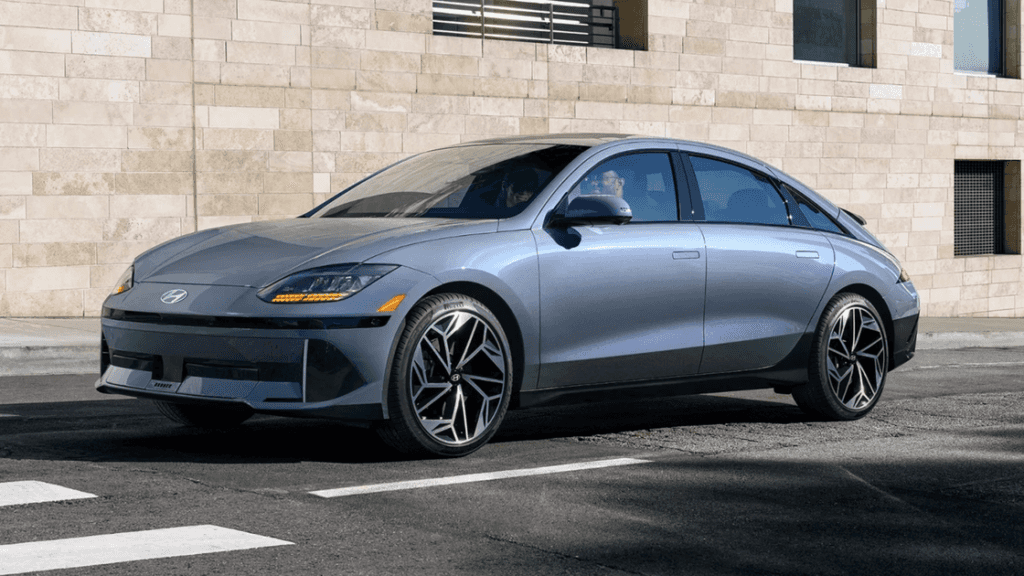
The 2025 Hyundai IONIQ 6 represents a refined approach to electric vehicle engineering. Developed with a focus on efficiency, performance, and functional design, this model offers multiple drivetrain configurations, high-capacity battery systems, a low drag coefficient, and a range of integrated safety and driver-assist technologies. Its design choices and internal systems are intended to maximize usability and energy efficiency in various driving conditions.
Powertrain Configurations and Output Efficiency
The 2025 Hyundai IONIQ 6 is offered with three distinct powertrain setups. The standard rear-wheel-drive variant is powered by a 111 kW permanent-magnet synchronous motor producing 149 horsepower and 258 lb-ft of torque. The long-range RWD option increases output to 168 kW or 225 horsepower, maintaining the same torque level. The dual-motor all-wheel-drive configuration pairs a 74 kW front motor with a 165 kW rear motor, delivering a combined output of 320 horsepower and 446 lb-ft of torque.
All models utilize a single-speed reduction gear transmission managed through shift-by-wire control. The drivetrain is supported by a drive mode selection system accessed via a steering-wheel-mounted button, allowing the driver to switch between Eco, Normal, Sport, Snow, and customizable My Mode settings. The maximum vehicle speed is electronically limited to 115 miles per hour.
Battery Systems and Charging Integration
Two high-voltage lithium-ion battery packs are available across the range. The standard-range battery offers a capacity of 53.0 kWh with a system voltage of 480V. The extended-range version upgrades this to 77.4 kWh at 697V. Battery energy density is rated at 69.1 Wh/lb for the standard unit and 73.2 Wh/lb for the long-range version.
Charge time varies by power source. Using a 240V AC Level II charger, the standard pack can reach 80% in 5 hours and 20 minutes, while the long-range unit requires 6 hours and 55 minutes. DC fast charging at 50 kW reduces this to 58 minutes and 73 minutes, respectively. At a 350 kW rapid charging station, both battery types achieve an 80% charge in 18 minutes. The charge port is located on the rear passenger side, and a preconditioning function is included for battery thermal management.
Disclaimer: Approximately 18 minutes to charge from 10% to 80% on a 350-kW, 800V DC ultra-fast charger. Actual charging time varies based on a number of factors, including current battery charge level, output of the charging unit, vehicle and battery settings, battery temperature and outside temperature. Ultra-fast charging stations are provided by independent companies and availability is not guaranteed.
Chassis and Suspension Systems
The 2025 Hyundai IONIQ 6 is constructed using a unibody frame composed of advanced high-strength steel and high-tensile materials. The suspension system includes a MacPherson® strut design with gas dampers in the front and a multi-link setup with gas dampers in the rear. This combination supports road stability and handling precision across all variants.
Braking performance is handled by a ventilated disc system with 12.8-inch front and rear rotors. The system integrates electronic brake-force distribution, anti-lock braking, regenerative braking paddles, and an active hydraulic booster. An electric parking brake with auto-hold functionality is included, along with hill start assist and brake assist as standard.
Steering and Maneuverability
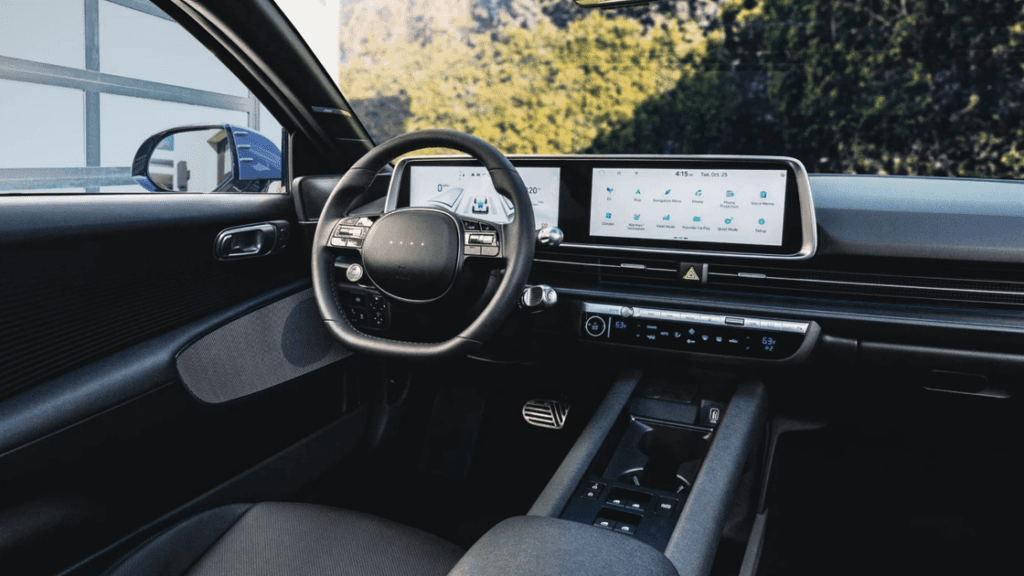
Steering is managed by a rack-and-pinion configuration equipped with motor-driven power assist. The system achieves an overall steering ratio of 14.27 and requires 2.66 turns from lock to lock. The turning diameter is 38.8 feet, contributing to maneuverability in compact environments. All models feature steering-mounted controls for audio, cruise, and regenerative braking adjustments.
Exterior Structure and Design Considerations
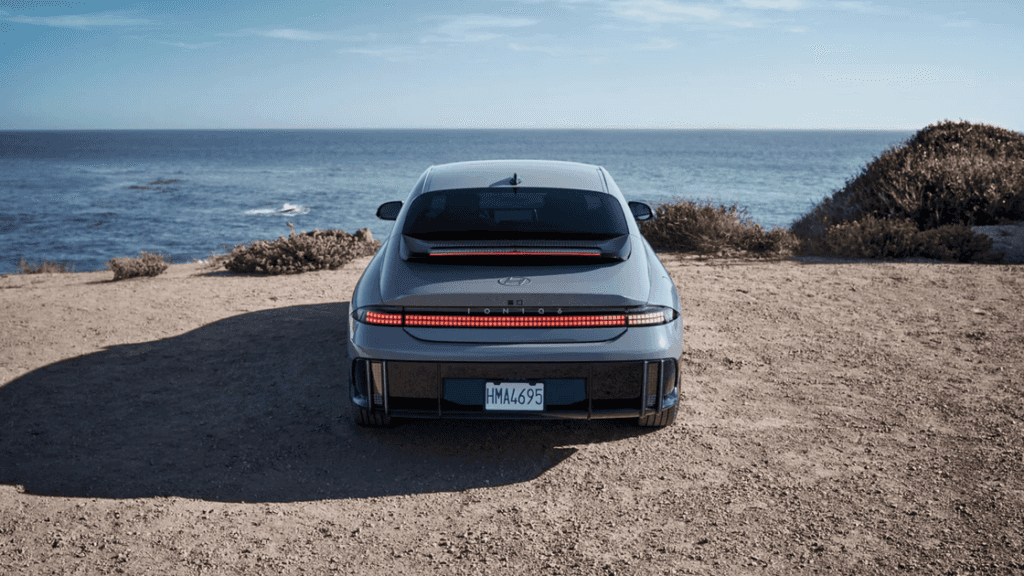
The 2025 Hyundai IONIQ 6 incorporates a streamlined body with an overall length of 191.1 inches, a width of 74.0 inches, and a height of 58.9 inches. The vehicle’s wheelbase spans 116.1 inches, and ground clearance measures 5.6 inches. Front and rear tread widths are dependent on wheel size, with 18-inch configurations providing 64.4 inches (front) and 64.7 inches (rear), while 20-inch configurations reduce these to 64.2 and 64.5 inches, respectively. The vehicle achieves a low coefficient of drag at 0.22.
Wheels are offered in two sizes. SE models feature 18 x 7.5J alloy wheels with 225/55R18 tires, while SEL and Limited trims upgrade to 20 x 8.5J wheels fitted with 245/40R20 tires. A tire mobility kit is included in place of a traditional spare.
Interior Features and Functional Layout
Cabin seating accommodates five passengers. Seat materials vary by trim, starting with stain-resistant cloth on base models and progressing to H-Tex® synthetic leather on higher trims. An 8-way power driver’s seat with lumbar support is standard. SEL and Limited trims add seat heating, while the Limited includes front-seat ventilation and memory settings.
The interior provides 103.0 cubic feet of passenger volume and 11.2 cubic feet of cargo capacity, with an additional 0.5 cubic feet of front under-hood storage. Rear seats include a 60/40 split folding configuration with a center armrest and cupholders. Dual-zone automatic temperature control, second-row air vents, and a heat pump system manage cabin climate. All trims come with a cabin air filter and rear defroster with a timer.
Display Systems and Controls
Instrumentation includes a 12.3-inch digital cluster with EV-specific readouts such as power gauge, charge level, and regenerative braking indicators. An AVN 5.0 infotainment system, also housed in a 12.3-inch touchscreen, includes navigation, AM/FM/SiriusXM®/HD Radio™, Android Auto™, Apple CarPlay®, and multiple USB charging ports. The Limited trim adds a Bose® premium audio system with eight speakers and an external amplifier.
Other features include dynamic voice recognition, wireless device charging (SEL and Limited), and Bluetooth® multi-device connection. A head-up display is newly introduced for the 2025 Hyundai IONIQ 6. Limited trims also include dual-color ambient lighting synchronized to driving speed.
Safety Engineering and Driver Assistance Systems
The vehicle includes comprehensive active and passive safety features. Passive systems consist of advanced dual front airbags, side thorax airbags, side curtain airbags, front and rear seatbelt pretensioners, and rollover sensors. Three-point seatbelts are standard at all seating positions, with adjustable upper anchors in the front row.
Active safety systems include electronic stability control, traction control, brake assist, and vehicle stability management. Tire pressure is monitored individually, with fill alerts provided per wheel.
Driver-assistance features vary by trim. All versions include forward collision avoidance with pedestrian and cyclist detection, lane keeping and following assist, driver attention warning, and high beam assist. Junction-turning support is present on SEL and Limited trims. Blind-spot collision warning is standard, while the SEL and Limited also include avoidance assist. The Limited trim adds a blind spot view and a surround view monitor.
Rear occupant alerts are included, as are rear cross-traffic collision avoidance, parking distance warnings, and safe exit warning. Highway Driving Assist is standard on the SE and upgraded to version 2 on the SEL and Limited trims.
Schedule a Test Drive Today
Drivers interested in evaluating motor output, rapid charging capability, and integrated safety functions may schedule a test drive of the 2025 Hyundai IONIQ 6. This experience allows for direct interaction with variable drive modes, regenerative braking settings, and digital control systems. Reviewing these features firsthand offers a clear view of the vehicle’s electric performance in active conditions. The 2025 Hyundai IONIQ 6 is available for test drives at ALM Hyundai Florence near Conway, SC. Contact our dealership to arrange your visit and explore its EV systems in depth.