

2025 Hyundai Kona Electric near Conway, SC
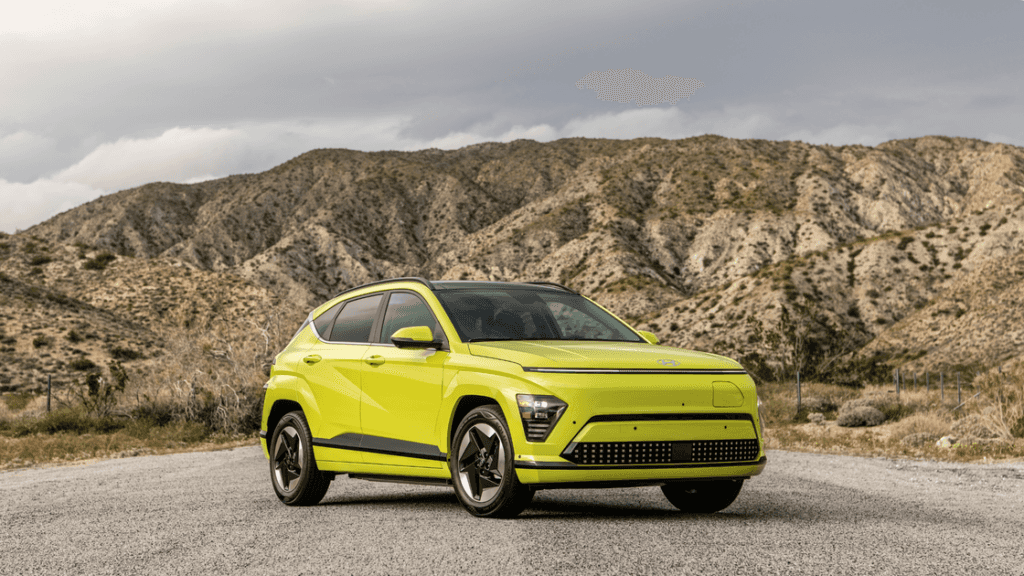
The 2025 Hyundai Kona Electric represents a comprehensive update in the electric compact SUV category. Built with advanced materials and optimized electrical architecture, it delivers consistent performance, efficient charging, and a refined driving experience. The vehicle features a permanent-magnet synchronous motor, a long-range lithium-ion battery, and a range of integrated driver assistance systems. Each trim is engineered to maintain balanced efficiency and reliability, presenting a vehicle that reflects the commitment of Hyundai to precise electric mobility design.
Power Delivery and Electric Motor Configuration
The 2025 Hyundai Kona Electric is equipped with a Permanent-Magnet Synchronous Motor designed for dependable power delivery. The SE trim produces 99 kilowatts, equivalent to 133 horsepower. The SEL, N Line, and Limited trims increase output to 150 kilowatts, or 201 horsepower. Across all variants, torque remains constant at 188 pound-feet, producing smooth acceleration under all drive modes.
A single-speed reduction gear transmission operates with a 10.65 gear ratio, creating consistent power flow through a front-wheel-drive system. Drive Mode Select offers four modes, including Eco, Normal, Sport, and Snow. Each mode modifies power mapping and steering response to match specific surface conditions. The shift-by-wire system eliminates mechanical linkage, allowing quicker gear engagement and improved efficiency.
The vehicle achieves a top speed electronically governed at 107 miles per hour for higher trims and 101 miles per hour for the SE. The combination of electric torque and low drivetrain friction creates a steady response without lag. The motor-driven power steering from Hyundai is using a rack and pinion type system and maintains an overall steering ratio of 13.6 to 1 with 2.5 turns lock to lock. This configuration enables precise control during both city and highway operation.
Battery Systems and Charging Efficiency
The 2025 Hyundai Kona Electric uses the brand’s latest lithium-ion battery systems with two voltage and capacity configurations. The SE trim carries a 48.6 kilowatt-hour battery operating at 269 volts, while the SEL, N Line, and Limited trims feature a 64.8 kilowatt-hour long-range battery at 358 volts. The standard range model provides an estimated 200 miles per charge, and the long-range version extends capability to 261 miles. The N Line trim delivers an intermediate 230-mile range.
Both batteries support Level II and Level III charging through an 11-kilowatt onboard charger. Using Level II power, a full charge from 10 to 100 percent requires approximately six hours. With a 100-kilowatt DC fast charger, the system replenishes from 10 to 80 percent in about 43 minutes. The charge port is integrated into the front grille and driver-side area for convenient access. A battery heating system is standard, maintaining optimal operating temperature in colder conditions to preserve efficiency.
Each battery pack utilizes a one-parallel, seventy-two- or ninety-six-series cell arrangement with total system capacities matched to trim levels. The long-range pack produces up to 182 kilowatts with an energy density of 69.1 watt-hours per pound, while the standard battery achieves 128 kilowatts and 63.3 watt-hours per pound. Hyundai incorporates an active cooling and control structure for consistent power output during extended use.
Disclaimer: EPA-estimated 261-mile driving range for 2025 KONA Electric Limited and 2025 KONA Electric SEL; EPA-estimated 230-mile driving range for 2025 KONA Electric N Line; and EPA-estimated 200-mile driving range for 2025 KONA Electric SE. All figures are EPA estimates and based on a fully charged battery. For comparison purposes only. Battery capacity decreases with time and use. Actual range will vary based on a number of factors, including vehicle options, driving conditions and habits, vehicle and battery’s condition, battery temperature and outside temperature.
Mechanical Architecture and Structural Design
The 2025 Hyundai Kona Electric is constructed on a unibody frame made of advanced high-strength steel and high-tensile steel for rigidity and safety. Its suspension system combines a MacPherson® strut design with coil springs at the front and a multi-link configuration at the rear. Shock absorbers are fitted on both ends to balance handling stability with ride comfort.
Braking components include ventilated 305 by 25 mm discs in front and solid 300 by 10 mm discs in the rear. The braking system integrates regenerative control paddles, allowing energy recovery during deceleration. Additional support systems such as Electronic Brake-force Distribution, Hillstart Assist Control, and Brake Assist operate with an active hydraulic booster for consistent stopping performance.
The transmission fluid capacity is 2.8 liters, ensuring reliable lubrication across the single-speed reduction system. The overall drive configuration and structural composition support efficient weight distribution. Each model uses a non-traction 12-volt electrical system to manage auxiliary components and accessories.
Exterior Design and Functional Components
The exterior of the 2025 Hyundai Kona Electric focuses on aerodynamics and practicality. Standard features include LED projector headlights with LED daytime running lights and LED combination taillights. High Beam Assist adjusts illumination automatically for improved visibility.
Wheel and tire configurations vary by trim, including 17-inch alloy wheels on SE and SEL models and 19-inch alloys on the N Line. Tires are rated at 215/60R17 for standard trims and 235/45R19 for the performance-oriented variant. Active grille shutters regulate airflow across the front fascia to improve drag efficiency. Body panels and bumpers are color-matched, while the N Line includes gloss black lower door garnish for distinction.
Functional elements such as heated outside mirrors, LED turn signals, solar front glass, and privacy glass on higher trims enhance usability. The integrated rear spoiler, roof rails, and shark-fin antenna provide aerodynamic and aesthetic balance. Limited models add a power tilt-and-slide sunroof and hands-free smart liftgate for additional convenience. The charge-port door opens with a push-release mechanism and is built into the front bumper.
Interior Layout and Control Systems
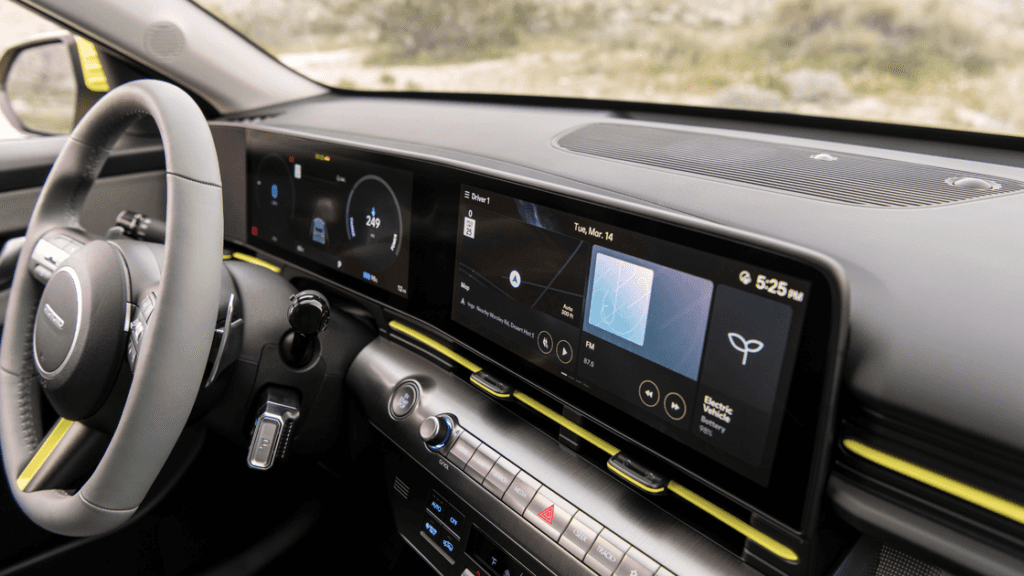
The cabin design of the 2025 Hyundai Kona Electric supports practicality and advanced digital integration. Seating accommodates five passengers with available cloth, Alcantara® combination, or H-Tex® leatherette surfaces depending on trim level. Front seating options include 6-way manual adjustment on the SE and 8-way power adjustment with lumbar support on higher trims. Heated front seats are standard beginning with the SEL, while ventilated seats are included on Limited trim. The rear seats feature 60/40 split folding with recline functionality and adjustable head restraints.
Cargo storage capacity measures 25.5 cubic feet behind the rear seats and expands to 63.7 cubic feet with seats folded. A dual-level cargo floor and four anchor points are standard. An additional front under-hood storage tray offers 0.95 cubic feet of supplemental space.
A 12.3-inch touchscreen navigation system combines AM/FM, SiriusXM®, and HD Radio™ with 6 speakers standard and a Bose® 8-speaker configuration available on upper trims. Wireless Apple CarPlay® and Android Auto™ compatibility, front and rear USB-C outlets, and a wireless device charging pad are standard or available across trims. The 12.3-inch digital instrument cluster displays speed, power output, range, and drive mode information with customizable brightness levels.
Dual automatic temperature control includes an auto defog feature and a driver-only mode for efficiency. Rear seat heater ducts, second-row air vents, and a PTC electric heater maintain cabin comfort. A leather-wrapped steering wheel provides integrated audio, cruise, and Bluetooth® controls. Regenerative braking paddles are mounted behind the wheel for direct access.
Storage features include a fixed armrest console, dual front cupholders, an illuminated glove compartment, and multiple door storage areas. Hyundai integrates OTA software update capability, Bluelink® connectivity, and WiFi hotspot functionality into every model.
Safety and Driver Assistance Technologies
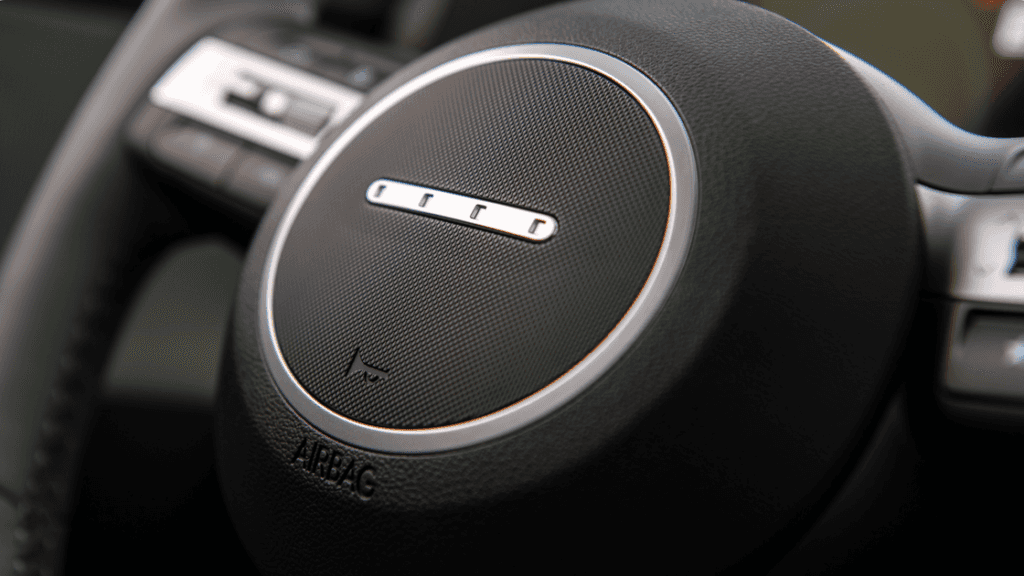
The 2025 Hyundai Kona Electric includes a comprehensive array of active and passive safety systems. The airbag system consists of advanced dual front airbags, thorax side-impact airbags, and side-curtain airbags with rollover sensors. All seating positions feature three-point seatbelts with pretensioners and load limiters. Rear LATCH anchors and upper tethers are standard for child seat installation.
Electronic safety systems include Anti-lock Braking, Electronic Stability Control, Traction Control, and Vehicle Stability Management. Each wheel and sensor is independently monitored to maintain braking and steering accuracy. Tire Pressure Monitoring provides individual tire readings.
The active driver assistance systems of Hyundai extend across all trims. These include Forward Collision-Avoidance Assist with pedestrian, cyclist, and junction detection; Lane Keeping Assist, Lane Following Assist, Intelligent Speed Limit Assist, and Highway Driving Assist I. Additional protection comes from Blind-Spot Collision Avoidance, Rear Cross-Traffic Collision Avoidance, Safe Exit Warning, and Rear Occupant Alert.
The Limited trim adds Remote Smart Parking Assist, Parking Distance Warning for forward, side, and reverse directions, and a Blind-Spot View Monitor. Structural integrity is reinforced through front crumple zones, bodyside reinforcements, and electronic shift lock mechanisms. Anti-theft and immobilizer systems are integrated with the keyless entry platform.
Dimensions, Interior Volume, and Performance Metrics
The vehicle’s wheelbase measures 104.7 inches, and the overall length is 171.5 inches for most trims and 172.6 inches for the N Line. Width extends to 71.9 inches, and overall height reaches 62 inches, or 62.2 with roof rails. Ground clearance stands at 5.9 inches. Roof rails carry a load capacity of 220 pounds.
Interior dimensions include 41.7 inches of front legroom and 36.4 inches in the rear. Headroom measures 40 inches in front and 38.3 inches in the rear. Shoulder room spans 56.5 inches in front and 55.2 inches in the rear, with hip room at 54.3 and 52.4 inches, respectively. Passenger volume totals 99 cubic feet, while total interior space reaches 124.5 cubic feet without the sunroof.
Curb weight varies from 3,571 pounds for the SE to 3,891 pounds for the Limited, with a gross vehicle weight rating of up to 4,883 pounds. Maximum trailer towing is not recommended.
Schedule a Test Ride Today
The 2025 Hyundai Kona Electric demonstrates precision electric vehicle design with refined battery systems, responsive drive control, and advanced safety technology. Its high-output electric motor, efficient energy recovery systems, and adaptable digital interfaces make it suitable for a wide range of driving conditions. At ALM Hyundai Florence near Conway, SC, drivers can explore the 2025 Hyundai Kona Electric firsthand. Scheduling a test drive provides an opportunity to experience the vehicle’s smooth acceleration, intuitive controls, and comprehensive driver assistance suite in person. The strong power delivery, advanced regenerative braking, and intelligent technology integration of the 2025 Hyundai Kona Electric represent the next phase of efficient electric mobility. Arrange your test drive to evaluate its technical performance and explore how Hyundai engineering continues to shape the future of electric transportation.