

2025 Hyundai Tucson near Conway, SC
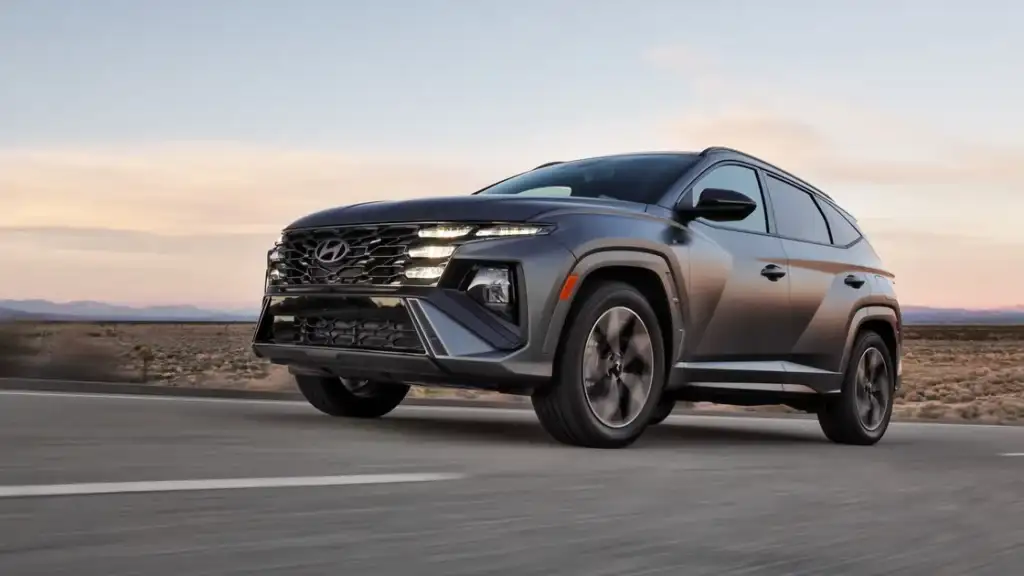
The 2025 Hyundai Tucson introduces an evolution in compact SUV engineering. Designed with precision, it offers three powertrain configurations: gasoline, hybrid, and plug-in hybrid. Each is optimized for efficiency, durability, and responsive driving dynamics. Built on a unibody chassis composed of advanced high-strength steel, the 2025 Hyundai Tucson balances rigidity with controlled flexibility, creating a stable foundation for the vehicle’s mechanical and safety systems. Every component, from its Smartstream® engine lineup to its integrated driver-assist technology, reflects a deliberate focus on technical performance and intelligent design integration.
Smartstream® Engine Design and Powertrain Systems
The 2025 Hyundai Tucson features the Hyundai Smartstream® engine technology engineered for reduced friction, improved combustion, and consistent torque output. The standard 2.5-liter GDI + MPI DOHC 16-valve inline four-cylinder engine has a displacement of 2,497 cc and employs Continuously Variable Valve Timing for optimized valve control. It produces 187 horsepower at 6,100 RPM and 178 lb-ft of torque at 4,000 RPM, supported by a high compression ratio of 13.0:1. The aluminum block and head structure aid in thermal management and overall weight reduction, while the variable intake system enhances airflow efficiency.
The hybrid and plug-in hybrid models incorporate a 1.6-liter Turbo-GDI DOHC 16-valve inline four-cylinder engine with Continuously Variable Valve Duration technology. The hybrid configuration delivers 231 horsepower and 271 lb-ft of combined torque, while the plug-in hybrid achieves 268 horsepower and the same 271 lb-ft of torque. These figures are achieved through a permanent magnet synchronous motor system paired with the gasoline engine.
Electric motor output reaches 47.7 kW, or 64 horsepower, in the hybrid and 72 kW, or 97 horsepower, in the plug-in hybrid. The torque from the electric motors measures 195 lb-ft in the hybrid and 224 lb-ft in the plug-in hybrid. The lithium-ion batteries supply 270 volts in the hybrid and 360 volts in the plug-in variant, with total system capacities of 1.49 kWh and 13.8 kWh, respectively. The plug-in model includes a 7.2 kW on-board charger and achieves a full charge in about two hours using a 240-volt outlet.
Transmission and Drivetrain Configuration
The 2025 Hyundai Tucson gasoline models use an eight-speed automatic torque converter transmission that supports smooth acceleration and consistent torque delivery. The hybrid and plug-in hybrid models are equipped with a six-speed automatic transmission designed to handle the instant torque from the electric motors without performance loss.
All configurations include a drive mode selector positioned on the center console that provides calibrated adjustments to throttle response and shift timing. Front-Wheel Drive is standard, while the Hyundai HTRAC All-Wheel Drive is available as an active on-demand system that continuously distributes torque to maintain traction. Paddle shifters mounted on the steering wheel and electronic Shift-by-Wire controls contribute to precise gear engagement. The final gear ratio for the gasoline engine is 3.648, while the hybrid and plug-in hybrid models use ratios of 3.320 and 3.367, respectively.
Suspension, Steering, and Braking Systems
The suspension system of the 2025 Hyundai Tucson combines a MacPherson® strut front design with coil springs and a multi-link rear configuration. Both ends include gas-pressurized shock absorbers and stabilizer bars for consistent control. The chassis construction uses a unibody design built primarily from advanced high-strength steel and high-tensile components to improve crash resistance and cornering stability.
Steering precision is managed by a Motor Driven Power Steering system with a 13.7:1 overall ratio, providing accurate directional feedback. The rack-and-pinion setup requires only 2.41 turns lock-to-lock and maintains a curb-to-curb turning diameter of 38.6 feet.
The braking system includes 12.8-inch ventilated front discs and 12.0-inch solid rear discs. Standard electronic safety mechanisms include Anti-lock Braking, Electronic Brake-force Distribution, Hillstart Assist Control, Downhill Brake Control, Brake Assist, and an Electronic Parking Brake with Auto Hold. These systems coordinate through four sensors across all four channels, ensuring balanced braking pressure under varying loads and surfaces.
Exterior Construction and Functional Design
The 2025 Hyundai Tucson features a refined aerodynamic profile with a coefficient of drag measured at 0.33. Overall dimensions include a 108.5-inch wheelbase, 182.7-inch length, 73.4-inch width, and a height of 65.6 inches for front-wheel drive and 66.3 inches for all-wheel drive models. The body maintains a ground clearance of 7.1 inches on front-wheel drive variants and 8.3 inches on all-wheel drive models.
Wheels are available in multiple configurations, including 17-inch, 18-inch, and 19-inch alloy designs, paired with corresponding tire sizes of 235/65R17, 245/60R18, and 235/55R19. All trims feature LED headlights, LED daytime running lights, and LED taillights, with higher trims incorporating projector-type Bi-LED systems. The inclusion of automatic headlights and High Beam Assist ensures consistent illumination across conditions.
Exterior elements such as heated mirrors with integrated turn indicators, solar glass, and an acoustic laminated windshield contribute to both comfort and efficiency. Functional features include roof rails, integrated spoilers, a shark-fin antenna, trailer pre-wiring, and an optional panoramic sunroof.
Interior Engineering and Digital Architecture
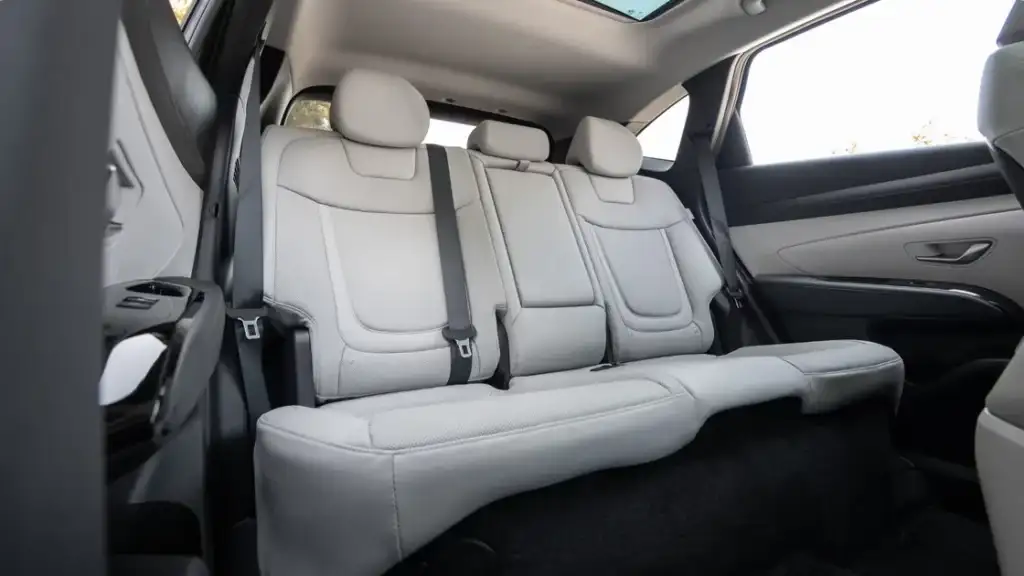
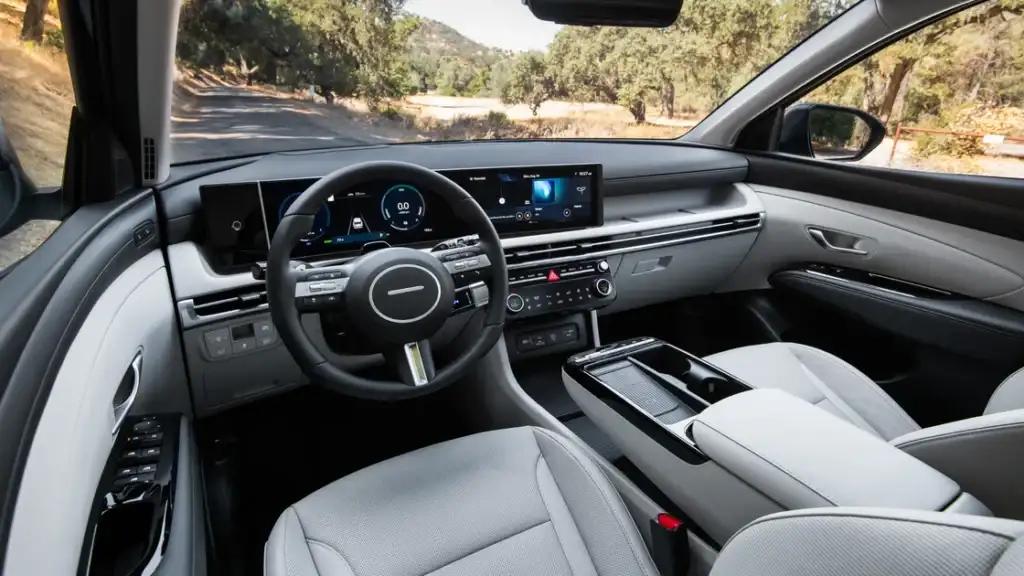
Inside, the 2025 Hyundai Tucson integrates digital systems with functional ergonomics. Passenger capacity is five, supported by seat designs that optimize lumbar support and cushioning. Depending on trim level, seat materials include cloth, H-Tex® leatherette, or leather upholstery. Power adjustments include an 8-way driver’s seat with lumbar support, while higher trims also provide an 8-way power passenger seat, ventilated front seats, and heated rear seats.
Cargo utility is maximized through a 60/40 split-folding and reclining rear seatback design with a dual-level cargo floor. The maximum cargo capacity reaches 80.3 cubic feet in gasoline models and 71.8 cubic feet in plug-in hybrid variants.
The dashboard includes a 12.3-inch digital instrument cluster and an available 12.3-inch touchscreen infotainment system with onboard navigation. All models feature wireless Apple CarPlay®, Android Auto™, and SiriusXM® integration. The optional Bose® 8-speaker premium audio system includes digital signal processing and speed-sensitive volume compensation.
Connectivity functions include multiple USB-C charging ports in the front and rear, a 15-watt wireless device charging pad, and the Hyundai Bluelink®+ connected car platform. Select trims include Hyundai Pay and Digital Key 2, offering NFC and ultra-wideband mobile access technology.
Climate management is handled through dual automatic temperature control with full capacitive-touch operation. Rear-seat heater ducts and after-blow logic maintain consistent air quality and prevent moisture accumulation. Ambient lighting with 64 selectable colors provides soft illumination without visual distraction.
Safety and Driver Assistance Integration
The 2025 Hyundai Tucson incorporates a full range of active and passive safety systems. Standard driver-assist features include Forward Collision-Avoidance Assist with pedestrian, cyclist, and junction detection; Blind-Spot Collision Warning; Rear Cross-Traffic Collision-Avoidance Assist; Lane Keeping Assist; Lane Following Assist; and Driver Attention Warning. Intelligent Speed Limit Assist and Smart Cruise Control with Stop and Go further enhance adaptive driving capability.
Advanced trims expand these systems with features such as Highway Driving Assist, Navigation-based Smart Cruise Control with Curve Control, Surround View Monitor, Blind-Spot View Monitor, and Parking Collision-Avoidance Assist.
The passive safety structure includes six airbags that cover front, side, curtain, and rear side protection, combined with seatbelt pretensioners and load limiters. Additional reinforcements along the bodyside improve side-impact resistance. Standard electronic stability control and traction control maintain consistent wheel grip during acceleration and cornering. The Tire Pressure Monitoring System provides individual tire indicators for accuracy.
Efficiency and Performance Metrics
Fuel efficiency ratings demonstrate the versatility of the 2025 Hyundai Tucson. The gasoline model achieves 25 miles per gallon in the city and 33 miles per gallon on the highway for front-wheel drive, while the all-wheel drive variant reaches 24 miles per gallon in the city and 30 miles per gallon on the highway. The hybrid model records an EPA-estimated 38 miles per gallon combined, and the plug-in hybrid achieves a combined 35 miles per gallon with an electric-only range of 32 miles. The plug-in model also records 77 MPGe when operating in electric mode.
Fuel tank capacity measures 14.3 gallons for gasoline, 13.7 gallons for hybrid, and 11.1 gallons for plug-in hybrid models. The 2025 Hyundai Tucson maintains SULEV30 emissions compliance, underscoring its balance between performance and environmental responsibility.
Disclaimer: 2025 TUCSON: FWD 25 City/33 Hwy/28 Combined MPG. HTRAC AWD 24 City/30 Hwy/26 Combined MPG. All figures are EPA estimates and for comparison purposes only. Actual mileage may vary with options, driving conditions, driving habits and vehicle’s condition.
Schedule a Test Drive Today
The 2025 Hyundai Tucson presents a combination of advanced powertrains, engineered suspension systems, and intelligent safety architecture. Its hybrid and plug-in hybrid options extend capability through efficient electric assistance, while every configuration provides the stability and control of precise drivetrain and braking systems from Hyundai. Visit ALM Hyundai Florence near Conway, SC, to explore the engineering quality and technology of the 2025 Hyundai Tucson. Schedule a test drive to experience its Smartstream® powertrain, hybrid efficiency, and advanced driver-assistance systems in motion. Discover how the 2025 Hyundai Tucson blends mechanical precision with intelligent design for confident performance across every drive.