

2026 Hyundai Elantra nearby Conway, SC
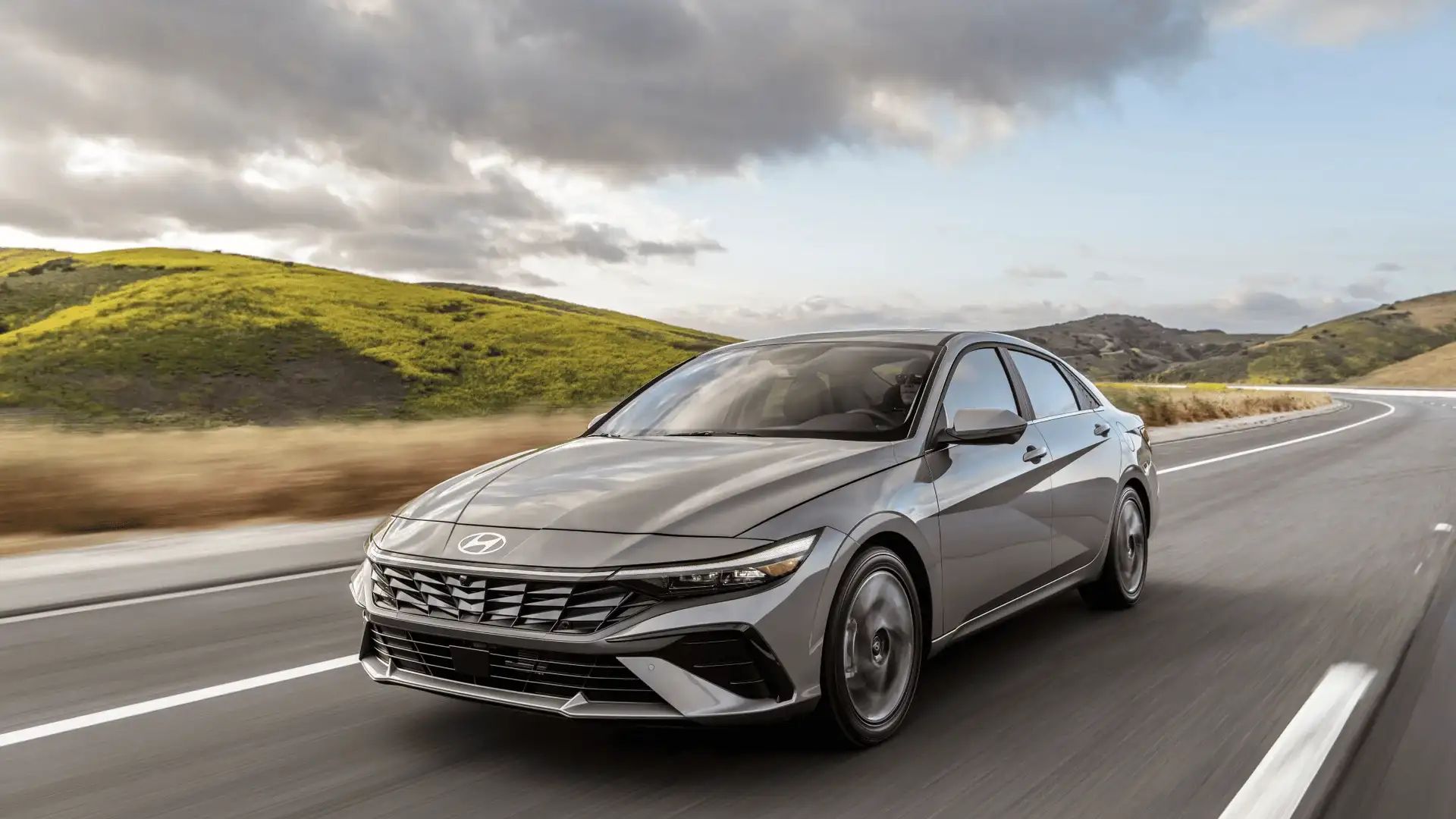
The 2026 Hyundai Elantra is a compact sedan with a broad technical range that includes gasoline, hybrid, N Line, and N performance configurations. Its equipment structure covers naturally aspirated and turbocharged engines, front-wheel-drive layouts, multiple transmission systems, electronic driver-assistance features, and trim-specific comfort and connectivity technologies. The model also uses distinct braking, steering, suspension, wheel, tire, and interior packages to support different performance and convenience priorities. Across the lineup, the 2026 Hyundai Elantra combines practical sedan packaging with detailed engineering specifications, including defined engine output, passenger volume, cargo capacity, and chassis hardware.
Powertrain and Performance Engineering
The 2026 Hyundai Elantra uses a diverse engine lineup that gives each major configuration a clearly defined mechanical character. Standard gasoline models use a 2.0L MPI Atkinson DOHC 16-valve inline 4-cylinder engine with a 1,999 cc displacement, D-CVVT, and an aluminum block and head. This engine produces 147 horsepower at 6,200 rpm and 132 lb.-ft. of torque at 4,500 rpm, with an 81 x 97 mm bore and stroke. Hybrid models use a 1.6L GDI Atkinson Cycle DOHC 16-valve inline 4-cylinder engine paired with an electric motor and lithium-ion battery system. N Line and N models add turbocharged engine choices that increase output and introduce performance-focused hardware.
Gasoline and Hybrid Engine Specifications
The 2.0L MPI Atkinson engine supports SE, SEL Sport, SEL Sport Premium, and Limited configurations with a 12.5:1 compression ratio. It uses intake and exhaust CVVT, 16-valve swing arms with hydraulic lash adjusters, a 2-step Variable Induction System, and Variable Charge Motion. The SE model also includes Idle Stop & Go, which adds an efficiency-oriented function for stop-and-start driving conditions. Recommended fuel for the 2.0L engine is unleaded, and its exhaust layout uses a single, unexposed design. The engine’s aluminum block and head contribute to the model’s technical specification while maintaining a conventional naturally aspirated layout.
The hybrid system uses a 1.6L GDI Atkinson Cycle engine with a 1,580 cc displacement, an aluminum block and head, and a 13.0:1 compression ratio. The gasoline engine produces 104 horsepower at 5,700 rpm and 109 lb.-ft. of torque at 4,000 rpm. The system also includes an interior-permanent magnet synchronous motor rated at 32 kW, or 43 horsepower, and 125 lb.-ft. of torque. Combined system output reaches 139 horsepower and 195 lb.-ft. of total torque. The hybrid battery is a lithium-ion unit with 240 volts and 1.32 kWh of battery system capacity.
Turbocharged N Line and N Powertrains
The 2026 Hyundai Elantra N Line uses a 1.6 Turbo GDI DOHC 16-valve CVVD inline 4-cylinder engine with a 1,598 cc displacement. This engine produces 201 horsepower at 6,000 rpm and 195 lb.-ft. of torque from 1,500 to 4,500 rpm. It uses an aluminum block and head, a 10.0:1 compression ratio, intake and exhaust CVVD, and 16-valve swing arms with hydraulic lash adjusters. Its intake system uses TIS, and the exhaust system includes a turbocharger with twin chrome-exposed exhaust outlets. These specifications give the N Line a distinct mechanical identity within the broader 2026 Hyundai Elantra range.
The Elantra N uses a 2.0L turbocharged direct-injected “Flat Power” 4-cylinder engine with a 1,998 cc displacement. It produces 276 horsepower from 5,500 to 6,000 rpm and 289 lb.-ft. of torque from 2,100 to 4,700 rpm. The engine uses an 86 x 86 mm bore and stroke, a 9.5 compression ratio, and premium fuel. Its intake system combines TIS and VIA, and its exhaust system uses large-bore exhaust outlets. This configuration also receives N-specific chassis and driveline hardware that separates it from the rest of the lineup.
Transmission, Drive Modes, and Driveline Layout
The 2026 Hyundai Elantra uses front-wheel drive across its listed configurations, but transmission selection changes by engine and model type. SE, SEL Sport, SEL Sport Premium, and Limited models use a Smartstream® Intelligent Variable Transmission. Hybrid models use a 6-speed EcoShift® Dual Clutch Transmission. N Line models list both a 6-speed manual transmission and a 7-speed DCT with a dry double plate and diaphragm spring. The Elantra N includes a 6-speed manual transmission and lists an N 8-speed Wet Dual-Clutch Transmission as an available configuration.
Transmission Functions and Gear Hardware
The Smartstream® Intelligent Variable Transmission gives the 2.0L gasoline models a continuously variable-style drive arrangement matched to the naturally aspirated engine. Hybrid models use a 6-speed EcoShift® Dual Clutch Transmission, which works with the gasoline-electric powertrain and its combined system output. N Line DCT models include SHIFTRONIC® manual shift mode with paddle shifters, adding driver-controlled gear selection through the steering wheel-mounted controls. The N DCT configuration also includes paddle shifters and pairs with the N 8-speed Wet Dual-Clutch Transmission. These transmission differences help define the operating character of the 2026 Hyundai Elantra across efficiency-oriented, conventional, and performance-focused configurations.
Drive Mode Select appears across automatic and DCT configurations, with mode availability depending on the model. SE, SEL Sport, SEL Sport Premium, Limited, Hybrid, and N Line configurations list Normal, Sport, and Smart modes. The Elantra N expands the drive mode structure with Eco, Normal, Sport, and N Custom 1 and 2 selections. This gives the N model a more specialized interface for performance-related vehicle settings. The different mode structures align with the model’s transmission and engine combinations rather than using one identical calibration across the entire lineup.
Steering and Chassis Response
The 2026 Hyundai Elantra uses rack-and-pinion steering across the model range. SE, SEL Sport, SEL Sport Premium, Limited, Hybrid, and N Line configurations use column-mounted Motor Driven Power Steering. The Elantra N uses rack-mounted motor driven power steering, giving the performance model a distinct steering assist layout. Most non-N configurations list a 12.9:1 overall steering gear ratio, 2.5 turns lock to lock, a 14.6-inch steering wheel diameter, and a 17.7-foot minimum turning radius. The Elantra N lists a 12.2:1 steering gear ratio, 2.2 turns lock to lock, a 14.6-inch steering wheel diameter, and a 19.2-foot minimum turning radius.
Suspension, Braking, Wheels, and Tires
The 2026 Hyundai Elantra uses suspension and brake hardware that changes by trim and powertrain configuration. All listed models use a MacPherson® strut front suspension, but stabilizer bar sizing, rear suspension design, and shock absorber specification differ across the lineup. Braking hardware also varies, with the N Line and N models receiving larger front brake equipment than standard gasoline and hybrid configurations. Wheel sizes range from 15-inch alloy wheels on SE to 19-inch alloy wheels on the N model. Tire specifications also change by configuration, including all-season tires on the N Line and summer tires on the N model.
Suspension and Body Construction
SE, SEL Sport, SEL Sport Premium, and Limited configurations use a MacPherson® strut front suspension with a 22 mm hollow front stabilizer bar, hydraulic twin-tube shock absorbers, and 2.3 mm coil springs. Their rear suspension uses a coupled torsion beam axle, gas-filled hydraulic monotube shock absorbers, and 2.1 mm coil springs. Hybrid models use a MacPherson® strut front suspension with a 23 mm hollow stabilizer bar, hydraulic twin-tube shock absorbers, and 2.4 mm coil springs. They also use a multi-link independent rear suspension with an 18 mm stabilizer bar and 2.7 mm coil springs. The body and chassis specification identifies a unibody structure using primary high-tensile steel.
N Line models use a MacPherson® strut front suspension with a 23 mm front stabilizer bar and a multi-link independent rear suspension with a 17 mm rear stabilizer bar. The Elantra N uses a MacPherson® strut front suspension and a multi-link independent rear suspension with Electronic Controlled Suspension. It also lists a 23 mm front stabilizer bar, a 24 mm rear stabilizer bar, a rear chassis brace, and an electronically controlled limited-slip differential identified as the N Corner Carving Differential. These components give the N model a more specialized chassis specification than the rest of the lineup. The variation in suspension hardware shows how Hyundai assigns different mechanical systems to standard, hybrid, sport, and performance models.
Braking System Specifications
SE, SEL Sport, SEL Sport Premium, and Limited models use 11.0-inch front ventilated disc brakes and 10.3-inch rear solid disc brakes. Hybrid models also use 11.0-inch front ventilated discs and 10.3-inch rear solid discs, along with an electric booster for the regenerative brake system. N Line models use 12.0-inch front ventilated discs and 10.3-inch rear solid discs, with a listed front rotor that is 1 inch larger than those of the 2.0L and hybrid models. The Elantra N uses 14.2 x 1.2-inch front ventilated brakes and 12.4 x 0.8-inch rear ventilated brakes, with 13.6-inch front rotors and 12.4-inch rear rotors also listed. Across the brake systems, ABS with Electronic Brake-force Distribution uses four wheels, four channels, and four sensors.
Brake Assist appears across the listed configurations, adding a consistent braking support feature throughout the lineup. Most standard gasoline models use a brake booster specification of 10 inches single for left-hand drive models and 8+8 inches tandem for right-hand drive models. The Elantra N lists an 11-inch single brake booster for left-hand-drive models and an 8+8-inch tandem booster for right-hand-drive models. Parking brake equipment includes a mechanical cable on SE and SEL Sport, with an electric parking brake from SEL Sport Premium and above. Hybrid SEL and Limited HEV configurations also list an electric parking brake, while N Line and N use mechanical cable parking brake layouts.
Wheels, Tires, and Exterior Lighting
The 2026 Hyundai Elantra SE uses 15 x 6.0J alloy wheels with 195/65R15 tires. Blue HEV uses 16 x 6.5J alloy wheels with 205/55R16 tires. The SEL Sport, SEL Sport HEV, Limited, and Limited HEV use 17 x 7.0J alloy wheels with 225/45R17 tires. N Line uses 18 x 7.5J alloy wheels with 235/40R18 Hankook Ventus S1 all-season tires. The Elantra N uses 19 x 8.0 alloy wheels with 245/35R19 Michelin® Pilot Sport 4 S summer tires.
Exterior lighting includes LED Daytime Running Lights and dual LED projector headlights across the listed configurations. Automatic Headlamp Control and Automatic High Beam Assist also appear across the lineup. Rear lighting changes by trim, with bulb rear taillights on several lower configurations, LED plus bulb rear taillights on selected higher trims, and full LED rear taillights on the N model. Exterior trim varies through black, glossy black, and matte black grille treatments depending on configuration. Additional equipment includes body-color door handles, a gloss black lip spoiler and diffuser on selected trims, a glossy black wing-type spoiler on the N model, and a matte black lower bumper and diffuser on the N model.
Interior Comfort, Seating, and Controls
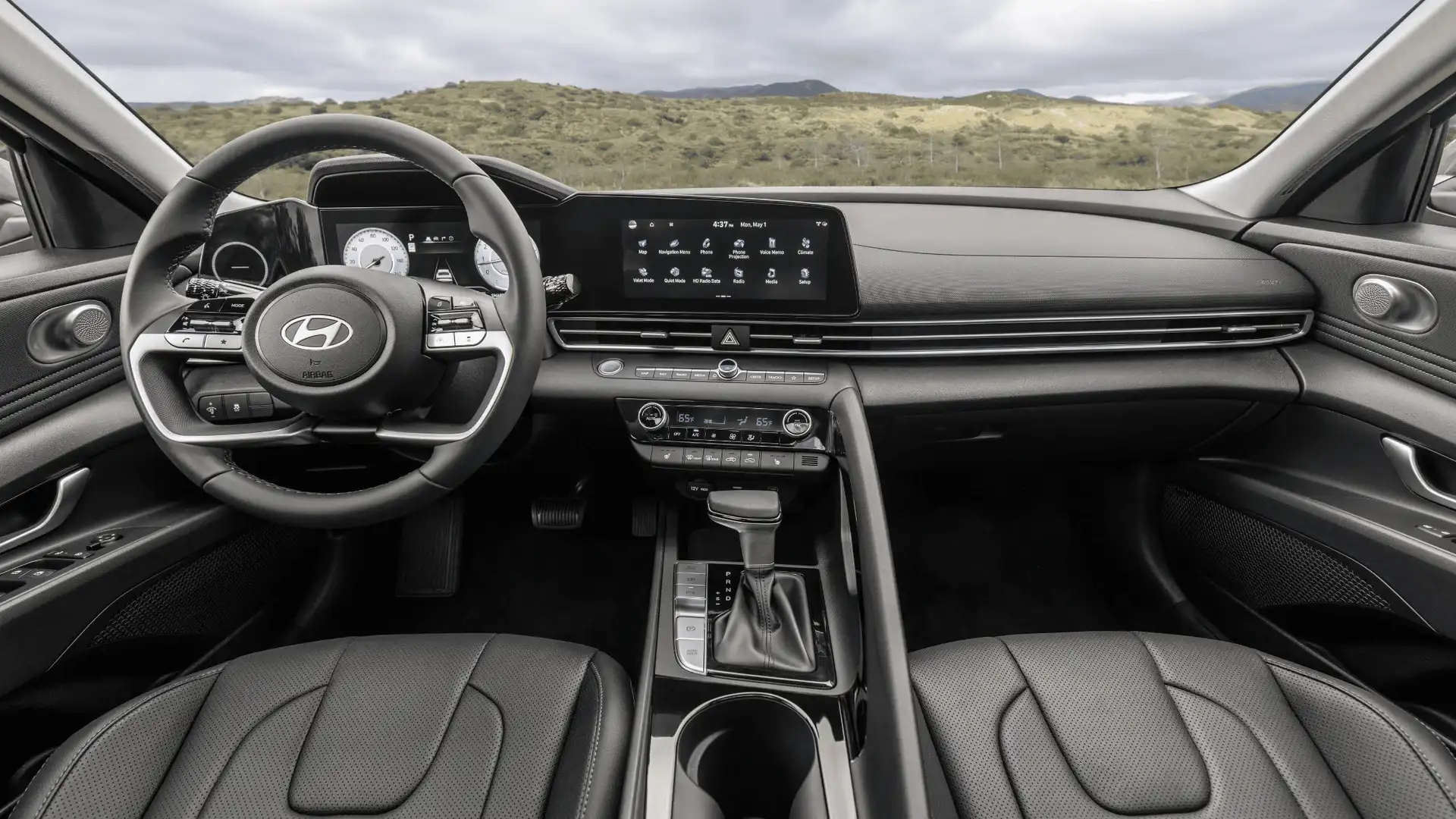
The 2026 Hyundai Elantra cabin seats five passengers and uses trim-specific seating surfaces, steering wheel materials, climate systems, storage features, and convenience equipment. Premium cloth appears on SE, SEL Sport, Blue HEV, and SEL Sport HEV configurations. The Limited and Limited HEV models use H-Tex® leatherette seating surfaces. The N Line uses leatherette and cloth combination sport seats, while the Elantra N uses leather-trimmed and microsuede combination N light sport bucket seats with an illuminated N logo. All listed configurations include a 6-way adjustable driver’s bucket seat, a 4-way adjustable passenger bucket seat, and front passenger slide and recline functionality.
Seating Materials and Adjustment Features
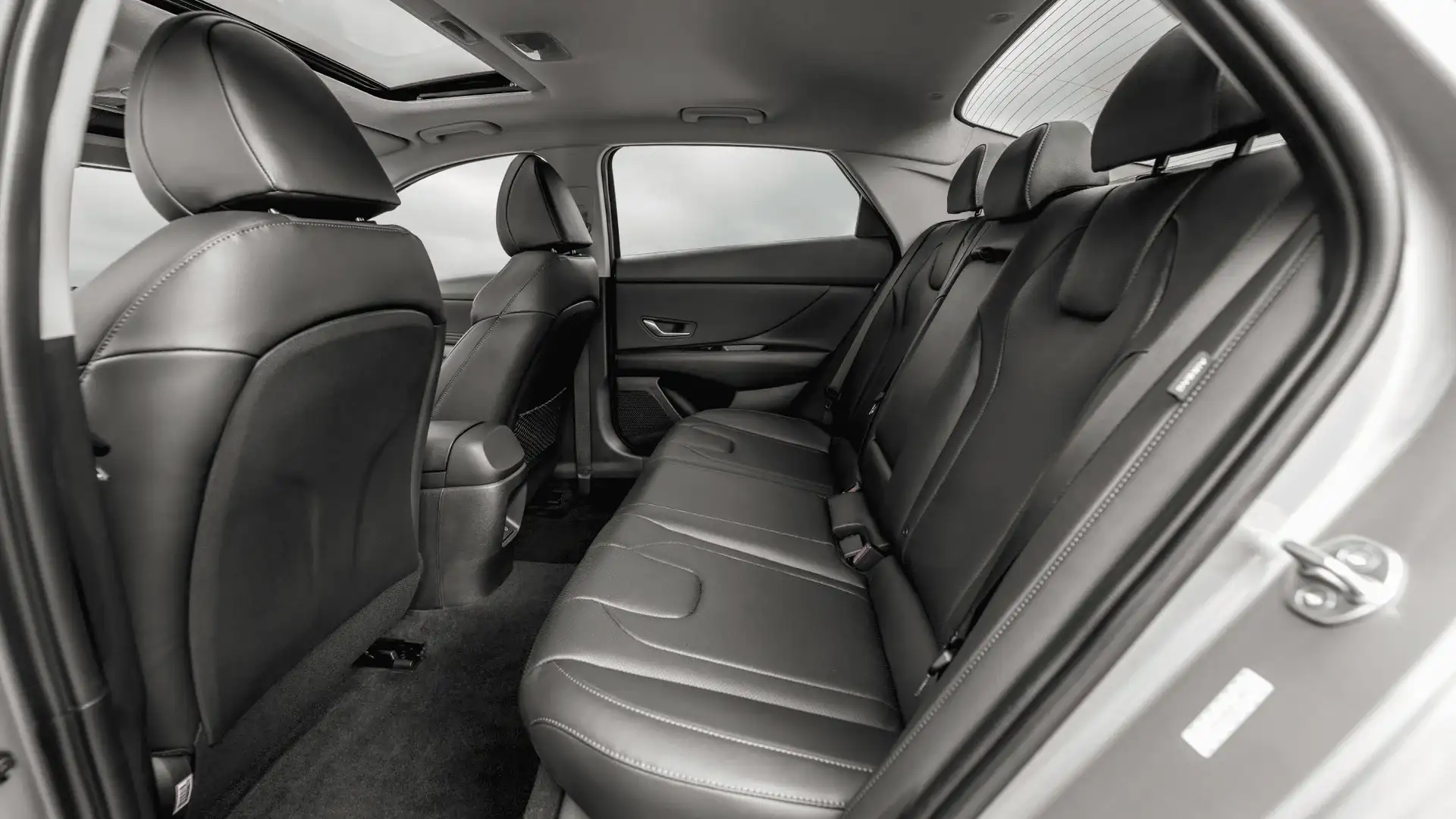
Heated front seats appear on SEL Sport Premium, Limited, Limited HEV, N Line, and N configurations. The Limited and Limited HEV models include a power driver’s seat with lumbar support, while the N Line also lists a power driver’s seat with lumbar support. Limited HEV adds an Integrated Memory System for the driver’s seat and outside mirrors, along with Seat Easy Access. Limited HEV also includes ventilated seats, giving it an additional comfort feature within the lineup. Rear seating includes either a 1-piece bench folding rear seatback or a 60/40 split fold-down rear seatback, depending on the trim, and all listed configurations include a seat-folding release in the trunk.
The 2026 Hyundai Elantra includes multiple storage and convenience features throughout the cabin. Front center console-mounted cupholders, a fixed front center console armrest storage box, a console storage box below the HVAC controls, and a trunk inner cover appear across the listed configurations. Door map pockets with bottle holders appear in the front and rear, and integrated door armrests are also listed across the lineup. Some models add rear cupholders mounted at the rear of the center console or in the rear center armrest. Remote releases for the hood, trunk, and fuel filler door appear across the convenience feature list.
Climate Systems and Driver Controls
SE uses manual air conditioning, while the rest of the listed configurations use dual automatic temperature control. Rear seat heater ducts and a rear window defroster appear across the lineup. Steering wheel materials vary by trim, with urethane, H-Tex®-wrapped, and leather-wrapped versions listed across different configurations. Every listed model includes a tilt and telescopic steering wheel, audio controls for volume, seek, and mode, cruise control, and Bluetooth® hands-free phone controls with Voice Recognition. These controls place frequently used functions on or near the steering wheel, supporting convenient access during normal vehicle operation.
Instrumentation includes either a 4.2-inch color TFT-LCD or a full TFT-LCD cluster with a 10.25-inch color TFT-LCD, depending on configuration. Standard meter and gauge information includes speedometer, tachometer, fuel level, digital odometer, trip odometer, digital clock, and external temperature. The Elantra N adds N Performance gauges, including turbo psi, throttle percentage, brake psi percentage, power, oil temperature, coolant temperature, and other performance-related readouts. Indicator and warning systems include digital PRND on automatic models, cruise control, turn signal and hazard indicators, a high-beam indicator, and blind-spot detection indication on the outside mirrors. Warning lights include oil pressure, battery charge, door ajar, airbag, seatbelt, low fuel, trunk lid open, brake, check engine, ABS, TPMS, ESC, and water temperature.
Technology, Audio, and Connectivity
The 2026 Hyundai Elantra uses multiple infotainment and audio systems across the lineup, with display size, speaker count, navigation availability, and connected services changing by trim. The SE, SEL Sport, and Blue HEV models list an 8-inch Display Audio system with six speakers. This system includes a high-resolution touchscreen, a rearview camera with Dynamic Guidance, AM/FM and HD capability, and wireless Apple CarPlay® and Android Auto™. Higher configurations use a 10.25-inch Navigation system with a high-resolution touchscreen, rearview camera with Dynamic Guidance, AM/FM/HD, SiriusXM® Satellite Radio, Android Auto™, and Apple CarPlay®. The navigation-equipped system also lists SiriusXM® Data Services, including NavTraffic, NavWeather, Sports, and Stocks with a three-month trial.
Audio Systems and Phone Integration
Bose® premium audio appears on Limited, Limited HEV, N Line, and N configurations. This system includes eight speakers, with a center channel and subwoofer. Bluetooth® hands-free phone capability with Voice Recognition appears across the lineup. Dynamic Voice Recognition appears on configurations equipped with the 10.25-inch Navigation system. These systems give the 2026 Hyundai Elantra several levels of audio, voice, and display functionality tied to trim equipment.
Wireless charging in Qi format appears on SEL Sport, SEL Sport HEV, Limited, Limited HEV, N Line, and N configurations. Dual USB ports appear across the lineup, including one USB charge and data port and one USB-C charge port. Two rear USB-C charge ports also appear across the listed configurations. Blue Link Connected Car Services and a Wi-Fi hotspot tied to Navigation appear on navigation-equipped models. Antenna equipment includes an in-glass AM/FM antenna across the lineup and a roof-mounted XM antenna on navigation-equipped configurations.
Convenience Technology and Access Features
The 2026 Hyundai Elantra includes several access and convenience technologies on selected trims. Proximity key entry with push-button start appears on SEL Sport, SEL Sport HEV, Limited, Limited HEV, N Line, and N configurations. A hands-free Smart Trunk release appears on selected models, adding trunk access convenience when the key is detected. Digital Key 2.0 Touch appears on selected higher configurations, giving those models an additional access method. Power windows with driver auto-down and illuminated power window switches appear across the lineup. Driver-side auto-up appears on all listed configurations except SE.
Power door locks include an ignition key reminder, 2-turn unlocking, and inside handle override functions. The trip computer provides distance to empty, average fuel consumption, average vehicle speed, and elapsed time across the listed configurations. A 12-volt outlet below the HVAC controls appears across the lineup. Auxiliary and USB input equipment also appears across the listed configurations. These features support the vehicle’s practical sedan layout by combining cabin storage, device connectivity, and access functions with the model’s display and audio systems.
Safety Systems and Driver Assistance
The 2026 Hyundai Elantra includes passive safety equipment, active safety systems, and driver-assistance technologies across the lineup. Passive safety equipment includes advanced front airbags for the driver and front passenger, an Occupant Classification System, driver and front passenger side-impact airbags, and side air curtains for front and rear passengers. Seatbelt equipment includes a 3-point ELR driver belt, 3-point CLR front passenger and rear belts, adjustable front-seat shoulder belt anchors, and front seatbelt pretensioners. LATCH lower anchors and upper tether anchors are also included. The model also includes an Event Data Recorder and a hood buckling crease and safety stops.
Active Safety and Structural Features
Active safety systems include ABS, Vehicle Stability Management, Electronic Stability Control with Traction Control System, Hill Start Assist Control, Brake Assist, and Tire Pressure Monitoring System. The 2026 Hyundai Elantra also includes a rearview camera with Dynamic Guidance through its display audio and navigation systems. Structural safety features include an energy-absorbing steering column, front and rear crumple zones, body side reinforcements, and a front crash box and straightened side members. The side body uses hot stamping with high-tensile steel. Rear door dual beams and Smart Pedal also appear in the safety equipment listing.
Driver-assistance technologies include Forward Collision-Avoidance Assist, with feature content varying by configuration. Camera-based Forward Collision-Avoidance Assist with pedestrian detection appears on multiple models. Sensor-fusion Forward Collision-Avoidance Assist with pedestrian, cyclist, and junction-turning detection appears on selected configurations. Blind-Spot Collision Warning with Rear Cross-Traffic Collision-Avoidance Assist, Lane Keeping Assist, Lane Following Assist, Driver Attention Warning, High-Beam Assist, Safe Exit Warning, Intelligent Speed Limit Assist, and Rear Occupant Alert appear across the listed driver-assistance chart. Smart Cruise Control with Stop & Go appears on selected higher configurations, while Highway Drive Assist appears on Limited and Limited HEV.
Dimensions, Passenger Space, and Cargo Capacity
The 2026 Hyundai Elantra has a 107.1-inch wheelbase and a 185.4-inch overall length across the listed configurations. Its overall width measures 71.9 inches, and the listed overall height varies by configuration. Most configurations list 55.7 inches of height, while some models list 55.9 inches. Minimum ground clearance begins at 5.3 inches on SE and reaches 5.5 inches on several hybrid, N Line, and N configurations. These exterior measurements define the sedan’s footprint and support its cabin and trunk packaging.
Interior measurements include 40.6 inches of front head room without the sunroof and 38.7 inches with the sunroof. Rear headroom measures 37.3 inches, front legroom measures 42.3 inches, and rear legroom measures 38.0 inches. Shoulder room measures 56.5 inches in front and 55.6 inches in the rear, while hip room measures 53.4 inches in front and 50.5 inches in the rear. Passenger compartment volume measures 99.4 cubic feet. Trunk volume measures 14.2 cubic feet, and total volume measures 113.6 cubic feet.
Visit ALM Hyundai Florence to Schedule a Test Ride
The 2026 Hyundai Elantra gives drivers several technical configurations to evaluate, including gasoline, hybrid, N Line, and N models with distinct performance, steering, braking, comfort, and technology equipment. Our team can help explain how the powertrains, transmissions, driver-assistance systems, cabin displays, seating features, and chassis hardware differ across the lineup. A test drive gives you a practical way to assess handling response, brake feel, visibility, infotainment controls, seating comfort, and safety technologies in one visit. Visit ALM Hyundai Florence near Conway, SC to schedule time with the 2026 Hyundai Elantra and review the configuration that best fits your driving priorities. We can walk through the model’s functional attributes in detail and help you compare its performance, technology, comfort, handling, and safety features with clear, model-specific information.