

2026 Hyundai Tucson close to Myrtle Beach
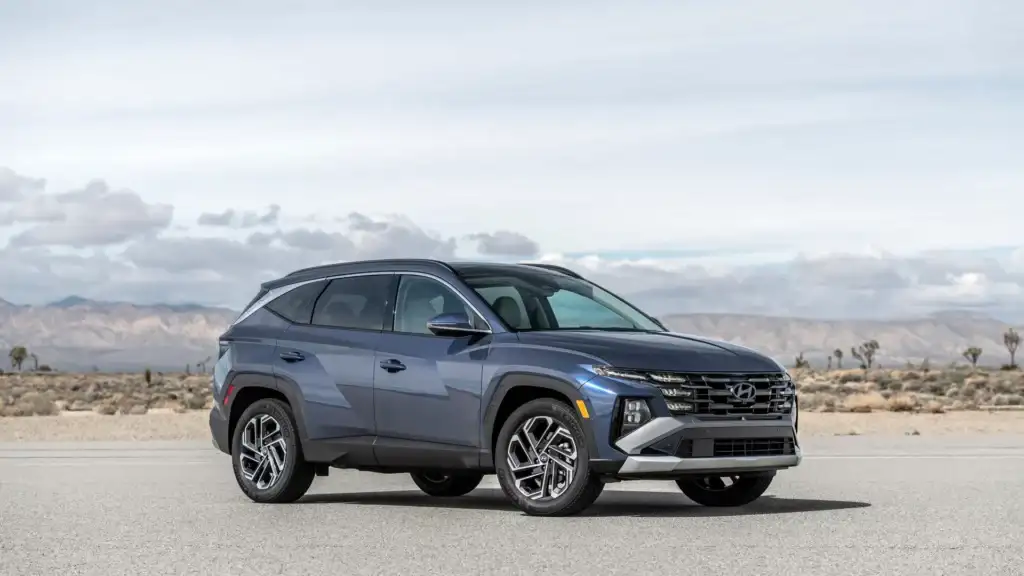
The 2026 Hyundai Tucson is a compact SUV designed with multiple powertrain configurations and a wide range of equipment focused on efficiency, utility, connectivity, and occupant comfort. The lineup includes internal combustion, hybrid, and plug-in hybrid models that share a common platform and chassis architecture while offering distinct mechanical characteristics. Across the range, the 2026 Hyundai Tucson incorporates Smartstream® engine technology, automatic transmissions, available HTRAC all-wheel drive, and a comprehensive collection of driver-assistance systems. Interior features emphasize digital displays, flexible seating arrangements, and practical storage solutions. This overview examines the 2026 Hyundai Tucson in detail, focusing on its powertrains, chassis systems, exterior equipment, cabin features, technology, safety systems, and dimensional specifications.
Powertrain and Mechanical Systems
The 2026 Hyundai Tucson offers several propulsion systems that support different driving requirements while maintaining a consistent engineering approach. Internal combustion models use a 2.5-liter Smartstream® GDI and MPI DOHC 16-valve inline four-cylinder engine with 2,497 cc of displacement and a full engine cover. This engine features Continuously Variable Valve Timing, an aluminum block and cylinder head, and a variable intake system. Idle Stop and Go technology is included on gasoline-powered models equipped with this engine. Hyundai specifies regular unleaded fuel and a SULEV30 emissions control system for these models.
Gasoline Engine Specifications
The 2.5-liter engine produces 187 horsepower at 6,100 rpm and 178 pound-feet of torque at 4,000 rpm. Bore and stroke measurements are 85.5 mm by 101.5 mm, and the compression ratio is 13.0:1. A hood insulator and front fender inner plastic cover are included as standard equipment. Exhaust flow exits through a single-tip exhaust system, while N Line models use a single twin-tip arrangement. These specifications provide the foundation for the conventional gasoline-powered configurations of the 2026 Hyundai Tucson.
Hybrid and Plug-In Hybrid Powertrains
Hybrid and plug-in hybrid models use a 1.6-liter Smartstream® Turbo-GDI DOHC 16-valve inline four-cylinder engine with 1,598 cc of displacement and a full engine cover. This engine incorporates Continuously Variable Valve Duration technology, an aluminum block and cylinder head, and a variable intake system. Gasoline engine output measures 178 horsepower at 5,500 rpm and 195 pound-feet of torque between 1,500 and 4,500 rpm. Bore and stroke dimensions are 75.6 mm by 89.0 mm, and the compression ratio is 10.5:1. These models also use regular unleaded fuel and meet SULEV30 emissions standards.
Electric Motor and Battery Technology
The 2026 Hyundai Tucson uses a permanent magnet synchronous motor producing 47.7 kW, or 64 horsepower, between 1,800 and 2,100 rpm. Electric motor torque reaches 195 pound-feet at 1,700 rpm, and total system output is rated at 231 horsepower with 271 pound-feet of torque. A lithium-ion battery with a maximum voltage of 270 volts and a 1.49 kWh capacity supports the system. Plug-in hybrid models employ a more powerful electric motor rated at 72 kW, or 97 horsepower, operating between 2,300 and 3,600 rpm. Combined output reaches 268 horsepower and 271 pound-feet of torque, while a 13.8 kWh lithium-ion battery operates at up to 360 volts and supports approximately two hours of charging through a 7.2 kW onboard charger connected to a 240-volt source.
Transmission and Chassis Engineering
The 2026 Hyundai Tucson combines its powertrains with automatic transmissions and drive systems designed to suit each configuration. Gasoline models use an 8-speed automatic torque-converter transmission, while hybrid and plug-in hybrid versions employ a 6-speed automatic torque-converter transmission. Front-wheel drive is standard on gasoline-powered models, and HTRAC active on-demand all-wheel drive is available. Hybrid and plug-in hybrid models include HTRAC all-wheel drive as standard equipment. Every configuration includes a center-console-mounted drive mode selector for convenient access to drive settings.
Steering and Braking Systems
All models use column-mounted Motor Driven Power Steering with rack-and-pinion geometry. The steering ratio measures 13.7:1, and the system requires 2.41 turns from lock to lock. Curb-to-curb turning diameter is 38.6 feet, providing maneuverability appropriate for a compact SUV. Braking hardware consists of 12.8-inch ventilated front discs and 12.0-inch solid rear discs. Anti-lock braking with Electronic Brake-force Distribution operates through four wheels, four channels, and four sensors. Additional systems include Brake Assist, Hillstart Assist Control, Downhill Brake Control, and an electronic parking brake with Automatic Vehicle Hold.
Suspension and Structural Design
The 2026 Hyundai Tucson uses a unibody construction composed primarily of Advanced High Strength Steels and high-tensile steel. Front suspension employs MacPherson® struts with coil springs, gas-pressurized shock absorbers, and a stabilizer bar. The rear suspension uses a multi-link arrangement with gas-pressurized dampers and an integrated stabilizer bar. This layout supports vehicle stability and ride quality while maintaining efficient packaging. The overall chassis architecture provides a common foundation across gasoline, hybrid, and plug-in hybrid models.
Exterior Features and Utility Equipment
Exterior design combines lighting technology with functional equipment intended to support visibility and utility. Wheel sizes vary by trim and include 17-inch, 18-inch, and 19-inch alloy wheels paired with corresponding tire dimensions. Depending on configuration, models use a compact temporary spare tire or a Tire Mobility Kit. Standard lighting equipment includes Bi-LED headlights, LED front turn signals, LED daytime running lights, automatic headlights, High Beam Assist, and a roof-mounted center high-mounted stop lamp. Certain trims add premium daytime running lights and projector-type headlamp assemblies.
Mirrors, Glass, and Exterior Details
Body-color side mirrors are standard across much of the range, while XRT models use black mirror housings with premium accents. Heated side mirrors are included on higher trims, and integrated turn signal indicators are available. Blind-Spot Collision Warning and Rear Cross-Traffic Collision-Avoidance Assist indicators are incorporated into the mirrors. Solar glass is used for the windshield and front doors, while an acoustic laminated windshield is standard throughout the lineup. Limited models add acoustic laminated front-side windows to further enhance cabin refinement. Exterior trim details include gloss black pillars, dark chrome grille accents, and body-color door handles.
Roof Systems and Cargo Access
Roof side rails are available across several trims, with bridge-type rails used on XRT models. Roof cross rails are available as accessory equipment. Rear functionality is supported by an integrated rear spoiler with a center high-mounted stop lamp and a hands-free Smart Liftgate with adjustable height settings. Trailer pre-wiring is standard throughout the range, and a tow hitch is available on selected models. A shark-fin roof antenna is also included as standard equipment. These features contribute to the practical design and utility capabilities of the 2026 Hyundai Tucson.
Interior Comfort and Seating
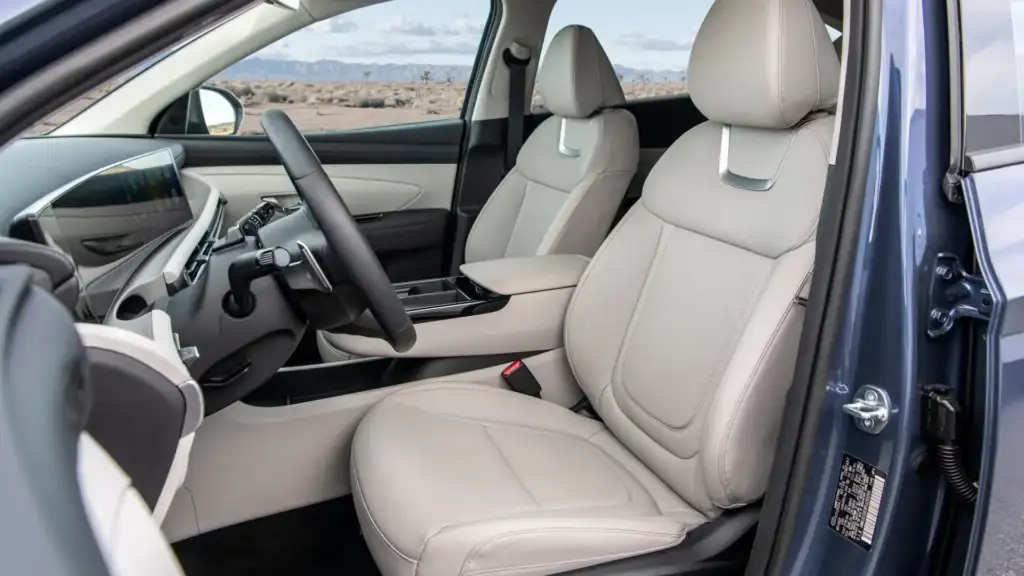
The cabin of the 2026 Hyundai Tucson accommodates five occupants and offers multiple upholstery materials depending on trim level. Cloth seats with stain-resistant and odor-resistant properties are available on lower trims, while H-Tex® leatherette and leather upholstery appear on higher grades. Seating configurations range from a six-way adjustable driver’s seat to power-adjustable front seats with lumbar support. Heated front seats are included on several trims, while Limited models add ventilated front seats and heated rear seats. Driver memory settings also extend to the outside mirrors and include a reverse dip function.
Rear Seating and Cargo Flexibility
Rear passengers benefit from a 60/40 split-folding seatback with reclining functionality and adjustable head restraints. Remote release mechanisms allow the rear seats to fold from the cargo area. A dual-level cargo floor is standard on most models, excluding plug-in hybrid versions. Six cargo tie-down anchors provide additional flexibility for securing items. A bag hook mounted to the second-row seatback further enhances utility. These features support versatile cargo management while maintaining passenger comfort.
Climate Control and Cabin Convenience
Climate management systems vary according to trim and powertrain. Manual air conditioning is fitted to entry-level models, while higher trims feature dual automatic temperature control with Auto Defogger functionality. Rear seat heater ducts, cabin air filtration, rear air vents, and a rear window defroster with timer are included throughout the lineup. After-Blow logic and external temperature displays are also standard. Interior convenience features include multiple cupholders, a center console storage compartment, dual 12-volt outlets, assist grips, and a damped glove compartment. Selected trims add wireless device charging, rain-sensing wipers, and an auto-dimming mirror with HomeLink capability.
Digital Technology and Connectivity
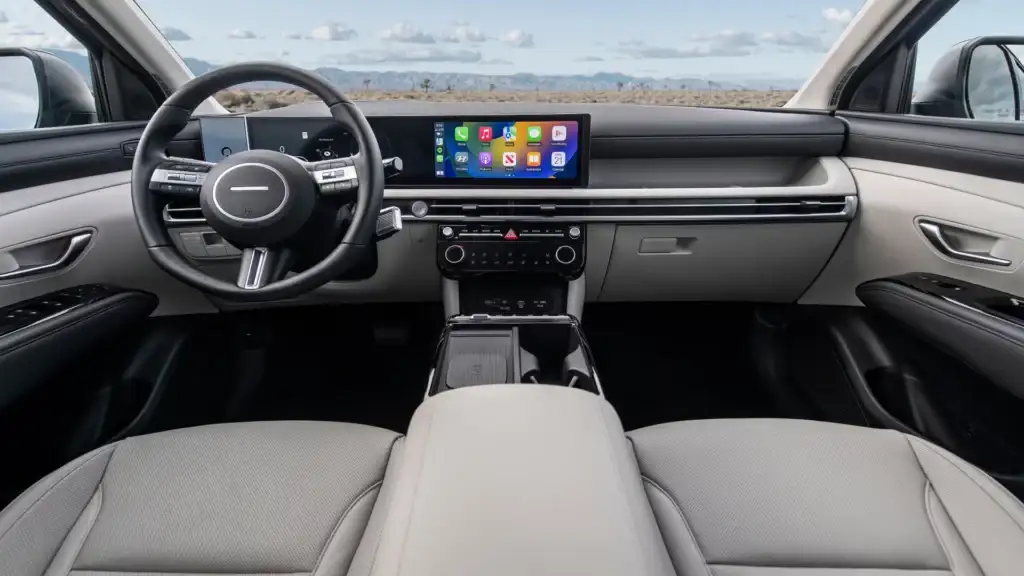
The 2026 Hyundai Tucson incorporates digital displays and connectivity systems intended to simplify access to information and entertainment functions. Most trims feature a 12.3-inch color touchscreen with AM/FM radio, HD Radio™ technology, SiriusXM® capability, and six speakers. Higher trims add integrated navigation and support for map and multimedia over-the-air updates. Wireless Apple CarPlay® and Android Auto™ are standard throughout the lineup. Front occupants have access to dual USB Type-C ports, and second-row passengers benefit from dedicated charging ports. A rearview camera is also standard equipment.
Audio Systems and Instrument Displays
Limited models include a Bose® Premium Audio System featuring an eight-speaker arrangement and a digital eight-channel amplifier. The system incorporates custom equalization, Digital Signal Processing, and Dynamic Speed Compensation. Instrumentation includes either a 4.2-inch Multi-Information Display or an available 12.3-inch digital instrument cluster. Standard gauges and indicators provide information related to speed, engine operation, fuel level, safety systems, and vehicle status. Adjustable illumination settings allow drivers to customize display brightness. This digital environment supports ease of operation and access to essential vehicle information.
Connected Features
Bluelink®+ Connected Car System is standard across the model range. Certain trims also include Hyundai Pay capability and Hyundai Digital Key 2 Premium functionality using NFC, BLE, and UWB technology. Additional convenience systems include Remote Smart Parking Assist and Smart Cruise Control with Stop and Go capability. Models equipped with Highway Driving Assist 1 also receive Smart Cruise Control 2. These features expand functionality while maintaining a user-friendly interface.
Safety and Driver Assistance Technologies
The 2026 Hyundai Tucson incorporates a broad collection of active and passive safety technologies. Occupant protection begins with advanced front airbags, front side-impact airbags, side curtain airbags with rollover sensors, and rear side airbags. The Occupant Classification System uses seat weight and seat track sensors to monitor front passenger status. Front and rear outboard seatbelts include pretensioners and load limiters. LATCH anchors, child safety locks, and a power window lock-out function contribute additional protection for younger passengers.
Driver Assistance Systems
Standard driver-assistance technologies include Forward Collision-Avoidance Assist with Pedestrian, Cyclist, and Junction Turning Detection. Blind-Spot Collision Warning, Rear Cross-Traffic Collision-Avoidance Assist, Lane Keeping Assist, Lane Following Assist, Driver Attention Warning, Intelligent Speed Limit Assist, and Safe Exit Warning are also included. Steering wheel haptic feedback supports Lane Keeping Assist and Blind-Spot Collision-Avoidance functions. Higher trims add features such as Highway Driving Assist 1, Navigation-based Smart Cruise Control with Curve Control, Surround View Monitor, Blind-Spot View Monitor, Parking Distance Warning, and Parking Collision-Avoidance Assist in Reverse. Radar-based Advanced Rear Occupant Alert is also available on selected models.
Stability and Security Systems
Electronic Stability Control, Traction Control, Brake Assist, and Vehicle Stability Management are standard across all models. Tire Pressure Monitoring with individual tire indicators provides continuous pressure information. Bodyside reinforcements contribute to structural integrity, while an anti-theft system integrated with remote keyless entry and panic alarm enhances security. An immobilizer is also standard equipment. Together, these systems create a comprehensive approach to occupant protection and vehicle security.
Dimensions and Cargo Capacity
The 2026 Hyundai Tucson rides on a 108.5-inch wheelbase and measures 182.7 inches in overall length. Overall width is 73.4 inches, while height ranges from 65.6 inches on front-wheel-drive models to 66.3 inches on all-wheel-drive versions equipped with roof rails. Ground clearance measures 7.1 inches on two-wheel-drive models and 8.3 inches on all-wheel-drive configurations. Aerodynamic efficiency is reflected in a drag coefficient of 0.33. Roof rails support a load capacity of 220 pounds.
Passenger Space and Interior Measurements
Front legroom measures 41.4 inches on gasoline and hybrid models, while rear legroom reaches 41.3 inches. Shoulder room measures 57.6 inches in the front and 56.0 inches in the rear. Front hip room is 54.5 inches, and rear hip room measures 53.9 inches. Interior volume without a panoramic sunroof reaches 146.9 cubic feet in gasoline models and 146.7 cubic feet in hybrid variants. Plug-in hybrid models provide 137.8 cubic feet of total interior volume.
Cargo and Fluid Capacities
Cargo capacity with the rear seats raised measures 38.7 cubic feet in gasoline and hybrid models using SAE measurements. Plug-in hybrid versions provide 31.9 cubic feet in the same configuration. With the rear seats folded, maximum cargo capacity reaches 80.3 cubic feet in gasoline models, 80.0 cubic feet in hybrid models, and 71.8 cubic feet in plug-in hybrid versions. Fuel tank capacity measures 14.3 gallons for gasoline models, 13.7 gallons for hybrid models, and 11.1 gallons for plug-in hybrid versions. Engine oil capacity is 5.6 liters on gasoline models and 4.8 liters on hybrid and plug-in hybrid configurations.
Visit ALM Hyundai Florence close to Myrtle Beach
Drivers interested in exploring the 2026 Hyundai Tucson can visit ALM Hyundai Florence close to Myrtle Beach to experience its engineering and features firsthand. We invite customers to evaluate the available powertrains, digital technology, seating comfort, and driver-assistance systems during a test drive. Our team can help explain the differences between gasoline, hybrid, and plug-in hybrid configurations while demonstrating key convenience and safety features. Experiencing the vehicle in person provides an opportunity to assess handling characteristics, cabin functionality, and connectivity systems. We look forward to helping you find the 2026 Hyundai Tucson configuration that best matches your needs.